Analysis of Mediarail.be - Signalling technician
(version française disponible ici)
More news, in english en french, on the facebook page of Mediarail.be
More news, in english en french, on the facebook page of Mediarail.be
After the Fyra disaster, belgians and dutch railways presented their projects for the future services between Amsterdam and Brussel. Not only from the national incumbents, but also from a private company. What plans are for the future ? A brief analysis.
Fyra out
The Fyra saga which marked the first three quarters of 2013 confirms the final eviction of the V250 train of AnsaldoBreda. There will be undoubtedly a legal saga that will take several years. The emergency replacement of a rail service has given birth to restart in mid-February the Benelux train before December 2012. The Fyra services was released train paths on classic lines that were transferred to the new regional services, mainly between The Hague and Amsterdam. The sudden return of the Benelux train came too late to reedit again a new transportation plan. This is why the Benelux Service was limited to The Hague, because there was no paths avaible beyond. The service consisted of 8 trains, and then after 10 trains per day, with the same rolling stock before (locomotive Traxx class 28 and coach ICRm). The Thalys service, preferred by SNCB, increased by 7 october from 9 to 11 returns trip per day, with 12 each friday (13 from december 2013). In this context, trafic grew by +44,2% since beginning of 2013.
 |
| The come-back of Benelux train, without "Olympics" livery (Mechelen, photo Mediarail.be) |
The Hague gets angry
The city, which has numerous embassy and which is the seat of the Government, has been excluded of direct connections with Brussel when the Fyra began his services last december. She had already been excluded of High speed rail connection because the dutch HSL joining directly Schiphol to Rotterdam without going through any station of the city. Isolated, The Hague reacted unexpectedly by setting up The Hague Trains Holding bv (THTH) on 8 February 2013, which is wholly owned by the municipality of The Hague. This possibility is now available because European rules make international connections open to everyone, by the rules of Open Access. The financial risk will be wholly funded by the chosen train operator. The sudden return of Benelux service don’t stop the project. For this time, The Hague has exactly what she wants : 12-13 trains per day with Brussels. But the city no longer wanted to deal with the national NS which has abandoned her with the adventure of the Fyra. A sort of revenge…The winning tender was revealed June 20, 2013: this is Arriva, a subsidiary of the national german rail operator DBAG. Meanwhile, SNCB and NS leaned on the future traffic between the two capitals.
Thalys will become a stand-alone company
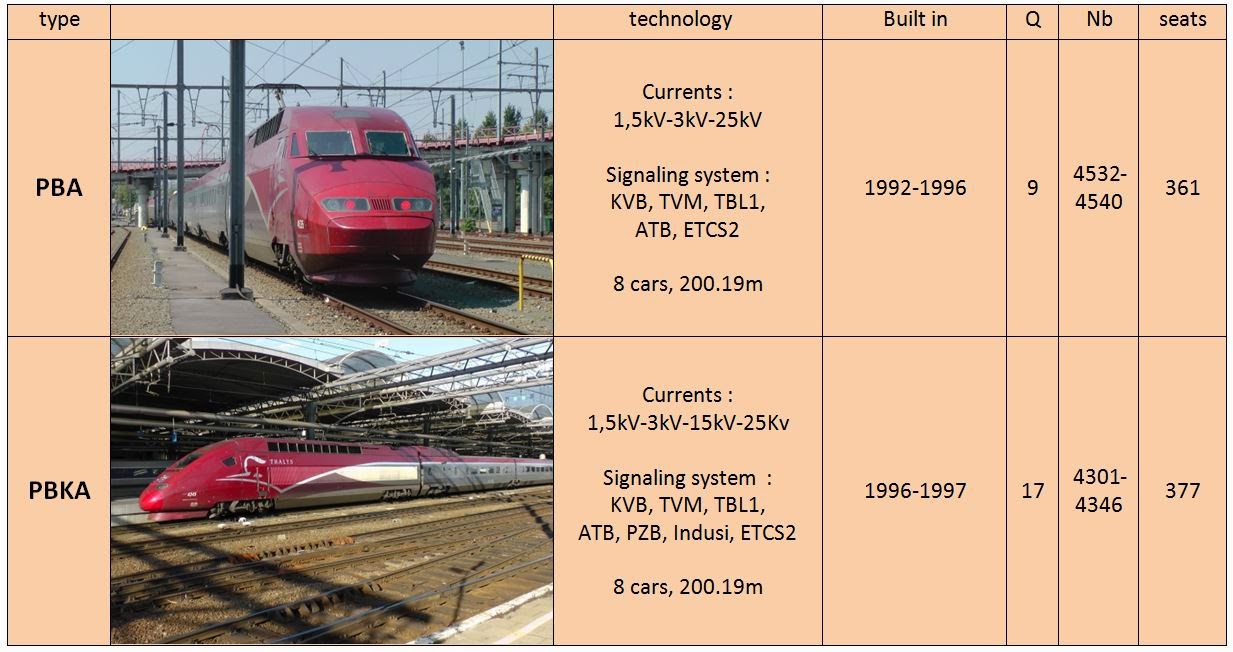
This was already in a way written in the stars : Thalys will become a real…french company from 2015, while SNCB's stake will increase from 28% to 40%. This means that henceforth neither the NS nor DBAG no longer form part of the company. The coming battle gave birth to a transportation plan presented by SNCB and NS September 27, 2013 and whose diagram is shown below:
 |
| The scheme 2016 (by NS - Netherland) |
We note that three routes pass through the HSL L4 toward Antwerp and Brussel with a total of 32 trains per day (including 2 new Eurostar Amsterdam-London). Two Thalys will have as route Amsterdam-Lille, a city where the french company is not present (this is the "garden" of SNCF's TGV and Eurostar). The scheme does not include the Arriva service on conventional lines we talked about earlier. It does not either incorporate the latest new: a request for an alternative plan for the operation of high-speed services from Amsterdam to Brussels via the HSL South high-speed line. This proposal come from …Arriva, meaning that the DBAG would hand over a portion of profitable traffic Dutch-Belgian. We note also that the diagram speaks of « IC » train, while the mention Fyra is definitively buried.
Rolling stock
14 Thalys projected future will probably always Alstom trains and it is not yet scheduled to date ordering new rolling stock. We know however, that the new Eurostar train Velaro e320 UK was being tested during summer and autumn in Belgium. His cousin Velaro D class 407 is also joined him in early September for the same series of tests, but it has nothing to do with the Dutch traffic because it is intended to Frankfurt-London connections via Brussels. But the Germans are now on the dutch tracks by their subsidiary Arriva. The connection The Hague-Brussels via Zaventem airport on conventional lines could be operated by Emu Stadler class "Flirt 3" with configuration "luxury" for longer distances. But this is an option, not a certainty. This will depend on the acceptance - or not - to ride with conventional rolling stock on HSL-Zuid, as currently with Fyra on domestic services between Amsterdam and Breda.
 |
| Emu or Dmu of Stadler are for regional traffic, but there exist a "long distances" version (ph Effimera59) |
Ultimately the Amsterdam-Brussels route is promised a strong battle between three or four companies, which could have an impact on prices. Another novelty will be to transit the Eurostar in Brussels-Midi, because currently they are received on two dead-ends. It will be set up a bonded platform in Customs terms. Wait and see…