Affichage des articles dont le libellé est Transport policy. Afficher tous les articles

Great-Britain : a brief overview of the railway regionalisation

Analysis of Mediarail.be - Signalling technician and railways observer
(version française disponible à ce lien)
More news, in english en french, on the facebook page of Mediarail.be
02/12/2014


History
As one of minister of Transport pointed in 90's, BR cannot run the railways effectively because, as a public body, its investment programme was always be constrained by the Treasury. Nationalized in 1948, British Rail passenger services were split in 1982 into three core sectors: InterCity, Network South East and Regional Railways. Beginning in the mid-1990s, the UK took the vertical separation idea and pushed it far beyond any point that the EU Commission had mandated. The old vertically integrated British Railways (national BR since 1948), was entirely broke apart, with the infrastructure privatized to the called Railtrack and the train services would be divided into 25 different franchises, such as ScotRail, Network SouthEast, the Gatwick Express and many others. After the well-known disaster of the concept of a private rail network, infrastructure was back in 2004 into a state company called Network Rail.

357031 arriving at Limehouse with a c2c service for Fenchurch Street on 14th October 2011 (photo by Roger Mark via flickr CC BY-NC-ND 2.0)
Regulation
At the central point of the system, operators have to contract on the one hand with the infrastructure manager and on the other hand with the rolling stock rental company. It is the Office of Rail Regulation (ORR) that proposes the government the level of income which can benefit Network Rail. The access rules are codified as they can be a source of litigation. As an independent regulator, ORR operates within the framework set by UK and EU legislation and is accountable through Parliament and the courts.


Rolling stock
When the Railways Act 1993 divided up track, rolling stock were sold In 1996 to three private companies called ROSCO. These companies lease the rolling stock to the train operating companies (TOCs) who then deploy it on their services. In addition, in recent years the Government has stepped in to procure large rolling stock orders directly from the train manufacturers. The average age of rolling stock across the GB rail network increased from a little over 15 years in 2007/08 to more than 18.5 years by 2012/13. This in itself masks significant variation: trains in Merseyside and on the Great Western route are on average more than 30 years old while trains on the Trans-Pennine and West Coast routes are less than 10 years old.

Franchising system
Competition within GB’s passenger rail sector currently takes place « for the market » by way of franchising system. They are not competition « in the market » between overlapping franchises or between franchised passenger train operators, in one word the « open access » like in Italy or Czech Republic is very limited. Franchises are contracts between government and private operators companies for the provision of passenger services in a defined area or lines. Initially there are 25 franchises but this number has since fallen to 16. They have ranged from approximately 3 to 15 years in term. Franchisees must perform the defined train services, achieve specified levels of efficiency, reliability, punctuality and recent franchises contain targets on passenger satisfaction metric. Train operators lease rolling stock and pay access charges to Network Rail for the use of infrastructure and stations. Concerning employment, the staff is transfered directly to the new operator at change of franchise and the new operator employ its own small management team.

Concerning bidders, the Department assesses the risk of financial delivery. Award is then made on the basis of price, with provision for other non-financial elements to be considered in the event of two bids being close financially. Companies then bid for the right to operate a franchise to that specification. The Government picks whichever company it thinks will deliver the best overall package for the franchise and give the best value for money. Franchise agreements include details of the performance standards that franchisees must meet and arrangements for the termination of a franchise in the case of failure to meet these standards.

The Department for Transport constantly identifies areas for improvement because franchises have a complex nature. The clash of this system in 2012 with the cancellation of InterCity West Coast franchise doesn't mean – according the 2012 Brown report - that the franchising system is broken. It seems clear that the department should have more adequate technical and legal resources to manage the study of franchise offers with efficiency. This brings to the forefront the question of a strong regulation and the clear objectives to be reached that are necessary for supervising the management of railway regional concessions. The Department announced a new schedule for rail franchising on 26 March 2013. This set out the full programme of upcoming franchises for the next 8 years, covering all franchises.


Negative results
As everybody knows, the results were mixed and Railtrack failed dramatically and brought back in 2004 into a quasi-public status to the so-called Network Rail. According The Independent (1), a study for Transport 2000 by the independent consultants Steer Davies Gleave concludes that the total railways bill will rise by 15 per cent over the decade after privatization. This is to pay for the added administrative burden of 25 franchise operators, three regulatory bodies and a separate track authority.

While franchising process had been largely successful to the Hatfield accident in October 2000, there has been much debate in Britain how much of the growth can be attributed to privatization through franchising as opposed to other factors, such as the very strong of the economy over the post-privatization period. According the website Just Economics bus and rail fares have skyrocketed since privatization and deregulation, yet up to 50 per cent of people in the UK do not have access to some kind of basic service (such as schools, hospitals and food stores) by public transport. Spending has tended to favour the most lucrative routes and those where passengers are prepared to pay most, rather than where the service needs of lower earners are greatest. Overall the poor find themselves paying over the odds for services that meet their needs only partially at best.

Negative results can also concern the Exchange. Last week, the value of First Group’s shares has fallen by £150 million, while Stagecoach has seen £33 million wiped from the value of its shares on mere rumor of the East Coast franchise won by a competitor. Finally, the winner was…Stagecoach !

Positive results
The results are they so negative? It works though if it’s believe the spin from the industry. Train operators are generating more than four times as much money for Government to invest in rail services than 15 years earlier, average price paid by passengers per mile is down, and more people are using the trains than ever. According Stagecoach, franchising creates a strong incentive for train companies to attract additional passengers to maximise revenue. Since privatization, train operators have delivered
22% more services and attracted over 60% more passengers.

Traffic has nearly doubled since 1997 and ORR publishes the overall subsidy per passenger mile on annual basis. According the Department for Transport’s, the competition for passenger rail services has been fairly vigorous ant that there have been no cases of collusion between bidders. There are a growing number of different companies that have and continue to compete for franchise competition. On his website ORR show also that rail use is on the rise as Britain's railways clocked up 1.23 billion journeys in 2011-12. This accounts for a 6% increase in rail passenger journeys compared with the previous year – the highest since records began in 1995-96. And recently it’s reported that the number of passenger journeys nationwide reached 393.9 million for the first quarter 2014-15, an increase of 2% compared to the same quarter last year (2).


Subsidies
The question of subsidies continues to be under heavy criticism in UK and when the british system is examined with many doubts by others European member states. Why ? Because in reality this system aims to achieve a significantly decline in volume of public funds. Is it the case ? As the website Outlaw.com reports, According to figures published by the Department for Transport (DfT), the total subsidy paid to franchised train operators was 6.8 pence per passenger mile in 2013/14; down from 7.3p per passenger mile in 2012/13. The total paid to rail operators by the government was £2.3 billion; down from the £3.2bn paid out in 2009/10. (ORR) showed that the rail network's overall share of government support rose by £227 million this year to a total of £5.3bn. However, this increase includes spending on infrastructure and major projects, such as Crossrail. «phenomenal growth in rail passengers is helping train operators to pay £2bn a year back to government – five times more than 15 years ago – with government choosing to reinvest this money in further improving Europe's best network,» said the Rail Delivery Group, which represents train operators and Network Rail.

However, according The Telegraph (3), the latest figures released by the Office of Rail Regulation (ORR) reveals that government funding varied from £2.19 for every passenger journey in England to £7.60 per passenger journey in Scotland and £9.33 in Wales. As a proportion of total income in 2012/13, England had the lowest level of subsidy, at 27 per cent of total industry income, compared to 56 per cent for Wales and 54 per cent for Scotland, the ORR report said. The Department for Transport defended the disparity, saying that the heavily-subsidised rail services provided a lifeline to rural communities.

Arriva, a company owned by german Deutsche Bahn. Dmu 158828 & 158819 leave Wellington on 25/10/11 with the a service to Holyhead (photo by Steve Jones via flickr_CC BY-NC-ND 2.0)

A good business for foreign companies !
Procurements for schemes such as the InterCity Express Programme, Thameslink and Crossrail have become mired in controversy due to the award of successive contracts to companies based largely outside of the UK. It isn't a mystery that three main railways in Europe are present in Great-Britain. According Buzzfeed, the French, German and Dutch state railways together run the majority of UK rail services in terms of passenger miles travelled. As reported Touchstoneblog, a research of the union RMT pretends that three quarters of the rail franchises in the UK are now owned by foreign state-owned or backed rail companies. The french SNCF via Keolis, the german DBAG via Arriva and the Dutch Railways NS via Abellio. 50 or 75%, the fact is that out of the 309 million passenger miles travelled on UK trains in 2012–13, 159 million were made on franchises either partly or entirely controlled by a foreign state railway. Dan McCurry, a Labour activist, has written : « We put these franchises out to tender because we wanted the private sector to provide their management know-how. It turns out that this company is not private sector but is the state sector of Holland. »

Europe in Britain, it's simply the result of the open market...

Back to public sector ?
This situation makes waves in UK. There is nothing that the political back court to understand the future of british railways. Many people think that a radical change is needed. Before to be ejected out of power, the Labour leaders had indicated  they is not ready to renationalise the lines and the coalition government remains committed to the existing system. But according The Guardian the Labour leader also said the party would let the public sector challenge private operators to take on the running of rail franchises, arguing it would improve services for passengers and end a situation in which foreign state-owned companies could compete to run trains in the UK without competition from a British equivalent (4).

Green Party leader Natalie Bennett, whose party supports renationalisation, said still that a return to public ownership would simple and inexpensive. « The fact that large amounts of the profits of our railways – coming from British pockets, whether by means of fares or taxes – are going to foreign governments just illustrates the absurdity of our current arrangements » she added.(5) But this « absurdity »  is simply an open market in Europe, widely asked by industrials and financials sectors from UK. A regret ?

Stagecoach finally won the East Coast Main Line franchise. Services begin in march 2015.(photo Ingy The Wingy via flickr CC BY-ND 2.0)

What’s the best future ?
The future would certainly not be a revived British Rail – which was a hopelessly inefficient organisation that as a nationalised industry had an uneasy relationship with Government that led to managerial paralysis.  This is a chance to build something far better and workable, drawing on the best practice of railway networks in Europe and beyond. According many politicians, tighter regulation, rather than state ownership, can seriously deliver improvements. Example of this new deal : in early 2011 the Government stated its intention to deliver more than 2,100 new rail carriages to the network by May 2019 (an increase of 1,850 net); and that the Department would negotiate with train operators to provide more and/or better rolling stock on a number of franchises. Deals for extra rolling stock were reached with Northern Rail, First Great Western, London Midland, Virgin West Coast, South West Trains and Southern at the end of 2011. The state became a rolling stock owner, without to become again British Railways...


Netherland : a brief overview of the railway regionalisation
Analysis of Mediarail.be - Signalling technician and railways observer
(version française disponible à ce lien)
More news, in english en french, on the facebook page of Mediarail.be

15th november 2014

The Netherlands is a relatively small but dense country with a population of 16.8 millions. The most densely-populated area, named « the Randstad » cover three big cities from Amsterdam to Rotterdam via The Hague (Den-Haag). Within a 50 to 150-km radius from this « Randstad » we can find other cities like Eindhoven, Utrecht or, in the south-east, Maastricht, and in the north, Groningen. It is a ideal situation for public transports and railways. The backbone of rail services in the Netherlands consists of national/inter regional rail traffic. These services are provided by the IC network, with within Randstad moreover rapid transit rail network.

The Dutch railway reform
Since long time, train service is operated by the vertically integrated national operator NS (Nederlands Spoorwegen). In the early 1990s, there was increasing dissatisfaction about the annual financial support in the form of subsidies because of the resulting heavy burden on the budget, and people had the impression that NS did not always use the money efficiently.  For the implementation of the European Directive in national law and establishing the future administrative and financial relationship between the State and railways, the Minister set up the independent Wijffels Commission. In 1992, this Commission issued its recommendation in the form of a report entitled « Sporen voor straks ». The Wijffels Commission identified four core functions of NS which could be transferred to separate business units, and NS became a holding.

Today, the NS Group (Nationale Spoorwegen groep), a holding with several subsidiaries. The state is for 100% shareholder. The financial contribution of the state has stopped, and since 2000 the NS is self-supporting. The NS Group employs 350 administratives employees; subsidiaries are Passengers (Reizigers with 10.000 employees), NedTrain (maintenance, with 3000 employees), NS Stations (500 employees) and NS International (600 employees).

In 2003, Dutch government created « ProRail », a state agency who responsible for 3.060 km of rail infrastructure, passengers stations, tram and metro excluded. Pro Rail, with 4.000 employees, manages the traffic-control and the path of all trains in Netherlands, both NS as other private company. Funding for ProRail is provided by a government subsidy, and a fee paid by the railway operators. 

Alstom Coradia LINT Dmu of Syntus (photo by Gerard Stolk via flickr - CC BY-NC 2.0)

Regionalisation
According a thesis (1), the aforementioned policies and legislation have been based on a certain economic motivation. The attempt of the general railway reforms has mostly been to improve transparency, whereas regionalisation has largely focussed on a greater efficiency and quality of regional transport. In 1994, the consultant McKinsey conducted a survey on behalf of the government and NS into the losses per line and per route, and identified 30 lines as unprofitable, laying the basis for the separation of the Dutch railway network into a main rail network and a regional/local network.

This was the base which introduced the reform of regional rail services by the Passenger Transport Act of 2000. The national/interregional part stands out as the profitable section of entire rail system. This segment remains under state control, while the train services on the main rail network are awarded by private tender to the current operator, Dutch Railways NS. The national company pays an annual fee of 30 € millions to the Ducht state for his exclusive right of exploitation. The aim of this legislation was to drive forward improvements of the other segment, local passenger transport from which it's necessary to recoup a greater share of costs (from 35% to 50% of total costs). This reform provides a framework for the regionalisation of local rail services, bus and metro systems. A total of 18 regional transport authorities were formed, based on the 12 provinces (in more rural areas) and of the "city-regions" of the country.   The Dutch state was treated as the « 19th transport authority » as it retained control of main line rail services – including local rail services operating over the main line routes.

Map of the 18 transport authorities. The 19th is the national Dutch NS.

Devolve powers and budgets of regional services to the province remains the responsibility of the national minister. The train services which were decentralised were all routes which NS had indicated as unprofitable in 1996. Since the reform Act, when decentralisation was introduced, the level of subsidies to the regional authorities should remain unchanged. Over time, a important quantity of local lines were transferred to the provinces as shown the map below. They can choose not only the national NS, but also another operator of their choice according to the method of the tendering and the attribution of a concession for a given time.

Three players
Outside of the national NS, there are currently 3 private players in the railway field. The first company which began the regional experience was Syntus in the east of the Netherlands who provided public transport in regions Overijssel, Gelderland and Twente. The company started prior to the Passenger Transport Act 2000 as a joint-venture between the national NS and a regional bus operator of the VSN-groep (Oostnet). Syntus resulted from an earlier regional project that aimed at better integrating the operations of buses and trains in this area, but lost recently a part. The company had responsibility for both bus and rail services and the staff, including drivers, were multi-skilled in both bus and rail.

(wikipedia)

Veolia Transport Nederland is a subsidiary of the french Veolia Transdev. Veolia started operating in the Netherlands when it took over BBA, the regional VSN bus company in the southern province of North-Brabant. In December 2006 BBA lost the part of the Brabant  but Veolia won the tender of the entire neighbouring province of Limburg. Veolia operates by with 24 trains on the Maastricht-Kerkrade and Roermond–Venlo-Nijmegen routes.

Arriva was a british company since 1938 and through a number of mergers and acquisitions was renamed in 1997, then was acquired in 2010 by the german railway incumbent DBAG. The company is a leading operator of passenger transport, and operates in 14 European countries. Arriva Netherlands is part of the Arriva Group and  entered in the Dutch market when it acquired the two former VSN bus companies in the North of the Netherlands. The territory was largely extended when it won several concessions in various parts of the Netherlands, including the concession for all regional rail lines in the North of the country. Today Arriva operates on 15 railways lines with 100 trains and on many lines of bus.

(Arriva fac sheet)
National ticketing
It is clear in Netherlands that concurrency is not an end in itself. Many others aspects must be take in account, like the multimodal ticketing. The Dutch government and regional transport companies have introduced in 2010 a Radio Frequency Identification (RFID) smart card for all public transport services, including national railway, called « OV-chipkaart ». This is an electronic card similar to the Oyster Card in use in London, that can be used for travel on all modes of public transport in the Netherlands. One of advantages under the current franchising regime is that this system should give transport companies precise information on their revenues by providing detailed information over all journeys made. The card replace since july 2014 all paper-ticket.

Upon boarding local transport, passengers scan their card and are charged a fixed check-in tariff of €4,00 (on the NS this tariff can be upwards of € 20,00 depending on the smartcard used). When exiting the vehicle, the user has the card read again (check-out) and the correct fare is automatically calculated, deducted and displayed (similar to the Oyster Card in London).

Employment
Everyone knows that the main resistances to the transformation of the railways are due to the particular employment conditions in railway sector. State railways NS had an own agreement for collective labor- and safety conditions, and working hours were monitored rigorously. Pro Rail is also covered by a company  collective labour agreement. Next to these two company agreements, there are 3 multi company collective agreements. They cover public local and regional transport (the multi modal collective labour agreement), the collective agreement Public Transport (Openbaar Vervoer) and the rail way infrastructure, named the « RIS agreement ».

Effect of regionalisation
Regional rail is subject to competitive tendering by regional authorities. Often bus and rail are combined into one multimodal concession. The modal share of railways is relatively high in the Netherlands: 9.7 % of all land passenger kilometres are made by train, comparing with 6,8% in Europe. Between 2000 and 2010, the number of passengers increased by 11.5% and NS remains the biggest rail transport operator with a market share of 90% of passengers-kilometers (2012). In the same period, the volume of traffic carried by the other operators on the decentralised regional lines more than doubled. The effect of decentralisation is estimated at a 20% increase in passengers.

On the financial side, and according a paper of the National Bank of Belgium, the BDU which the regional transport entities receive each year is used for the concessions put out to tender, which cover buses, trams and trains. This makes it impossible to separate the subsidies which accrue to the railways. Every year the Ministry of Transport and Water Management pays an average of € 1.6 billion to 12 provinces and 7 municipalities as a contribution for the implementation of the local and regional mobility policy. Of this, roughly € 1 billion is spent on the operation of urban and district transport, and the rest on infrastructure.

On the rolling stock side, the results are very visible. At the beginning of its operations, Syntus used the old Dmu of NS class « Wadloper » of DM90. In 2001, the company acquired 25 LINT Dmu (Alstom Coradia LINT 41/H), on the line Zutphen – Hengelo – Oldenzaal. 

Internal view of a LINT Coradia of Syntus (wikipedia)

Veolia also has procured in 2007-2008 a total of 16 new Stadler GTW diesel-electric articulated multiple units, 10 2-car units GTW 2/6 and 6 3-car units GTW 2/8 with an inner video surveillance system, a closed toilet system accessible for disabled people, a 1st class compartment with 220V connections, an information system using TFT screens and offers space for 2 wheel chairs and 6 bicycles. All this examples show the importance that has the tender system because it forces providers to offer the best rolling stock if they want to win the market.

(Stadler facsheet)
Conclusion
The Dutch idea was to split national InterCity traffic with the unprofitable local traffic that could be managed better on the regional and local level. According a study of Hitrans, the Dutch experience has been largely positive though there have been some problems with the size of the provincial councils resulting in some overlapping of services. The partnership between Groningen and Drenthe suggests that this need not be a major barrier if authorities are willing to co-operate. The relatively short franchise length (up to eight years) means that there is a degree of instability in the network. The loss of a large part of the Syntus network to the rival operator Arriva has been seen by some commentators as risking a decline in the high quality service currently provided. It was not the case but, what is clear is that the instability which is part of the franchising process have a risk of impact on both staff and passengers. Politicians must keep a vigilant eye on this problem.

But according the thesis mentioned above (1), an experience in the north of the country shown that the results of the public tender seems to have been successful. Paid subsidies have become a lot lower for the Groningen part of the concession and stayed roughly the same for the Friesland part. The service given in return with the spend is better than before and the train frequency and passengers growth has been increased. That's what is exactly expected from the franchising system by tendering.


(1) Railway regionalisation in the Netherlands - Wouter van der Kolk - Erasmus School of Economics (Rotterdam) 

HS2 : the sea snake of England
Analysis of Mediarail.be - Signalling technician and railways observer
08/10/2013

Like Sweden, Great-Britain is the only « big » countries with very few mileage of new High Speed Lines. Today the CTRL 1 comes to London from the Continent. But towards the North, there are no trains which ride over than 200km/h. The project HS2 (High Speed Two) is trying to catch up the delay, but it is facing a considerable debat between pros and cons. A little overview of the situation.

CTRL 1
The first real british High Speed Line (HSL) was built in two times. The first section was opened 29th of september 2003 and the second section, with more difficulties, the 14th of november 2007. This HSL is a copy of french HSL, with overhead line of 25kV and protection system TVM430, to the train station of St Pancras. The advantage of this location, on the north of London, is that St Pancras is head station from Midland Railways, while the nearby station of King Cross is the head station of ECML (East Coast Main Line), towards Newcastle and Edimburg. But towards the Wales, Midland and Scottland, you must go to the very dark station of Euston, 10 minutes walk from St Pancras. Not easy with luggages….

Geography
The Midlands is caracterized by a big concentration of cities from 100.000 to 2 millions people and many regions have experienced major growth of urban sprawl. As a result the Midlands looks like the german’s region of Rhur or the italian’s Lombardia, with a string of small and big towns at every 50 kilometer.  Four cities have a real importance : Birmingham, Manchester, Liverpool and Leeds. In this context, the railway’s network is very meshed and concentrates a large number of local and freight services.

WCML
The West Coast Main Line (WCML) is a main line of 640km joigned London to Glasgow via the Midlands and slip through this Midlands network.  This is the most important intercity rail passenger route in the UK which was entirely electrified in 25kV in 1974. Some sections allow a speed of 200km/h and the traffic reaches 75 million passenger journeys and 43% of all UK rail freight traffic . For all times, the main focus is to join Glasgow as fast as possible, today under the five hours, to compete with airliners. The first idea was to introduce a tilting train, in the 1970s, by the creation of the Advanced Passengers Train (APT), which never received any support of political authority. The backbone of express passenger services on the WCML from the 1970s to 1990s was the Mark II trains hauled by the BR class 87. At the time of privatisation, the franchise was awarded to Virgin which introduced the Alstom's Pendolino class 390. This franchise should have been renewed in october 2012 but a big mistake of the Departement of Transport (DfT) has cancelled all bids of bidders. Whatever the train services awarded, we are not in the case of a high speed train, although Virgin connects today London to Glasgow Central with a travelling time from 4h30 to 5h00.

The Pendolino class 390 ofAlstom : not a real high speed train (photo bob the lomond)

Arguments and counter-arguments
In Europe, the definition of a High Speed Train indicates a train which riding with a speed over 250 km/h without tilting system. This is the case of all HSL in France, Germany, Spain and Italy, as well as in the Benelux countries. At the beginning, the english project called HS2 was supported by a large political consensus, but the financial crisis and the grow of the sceptic political party has caused a large self withdrawal. Public opinion today is divided between the choice of a national concept and the improvement of his daily local life. Commuters have vigorously called for a hardly action to upgrade the regional traffic and do not understand why the gouvernement will spend dozens billions of £ to a project which they feel do not directly concern them. It is exactly the same argumentation presented by the opponents of the french HSL studied between Marseille and Nice (LGV PACA).

This is true that today the branding of TGV or the ICE has lost ground in the mind of many people, particularly by the fact that high speed trains does not responds to the wide array of destinations and that to connect a city at more than 1000 km, airliners stay the best way to travel, particularly with the low-cost services. Germany and France see that their motorway are not empty and that the high speed train has only ate a part of the growth of transports. The other argumentation is that the construction of HSL has left out the needs for regional and suburban traffic, except in Germany where the local traffic was improved at the same time that construction of HSL lines.

HS2
A first proposal called HS2 was presented in 2009 in UK to join major city centres served directly by HSL: London, Birmingham, Leeds and Manchester, and by extension on existing tracks, Liverpool and Scotland. In January 2009, the Labour government established High Speed Two Limited (HS2 Ltd) to study the possibilities  of a new British high-speed line towards Birmingham and Manchester. The first conclusion was presented to the gouvernment on 11 March 2010. But the parliamentary elections of may 2010 have replaced the Labour party by a  conservative gouvernement leading by David Cameron. Which published a slightly revised line of route for public consultation based on a Y-shaped route from London to Birmingham with branches towards Leeds and Manchester. A consultation period was set to run until July 2011 and when the results were published, it revealed that over 90% of respondents to the consultation were against HSL. In January 2012 the Secretary of State for Transport announced despite all the go-ahead for HS2 which would be built in two stages, causing a large protest movement and faced with many legal challenges.

Phases 1 and 2 of the project (photo Wikipedia)

Airport connection ?
It was also expected originally a option to connect HS1 with a International interchange station at Heathrow, with a line at north of London linked the CTRL1 via a by-pass already built just out the entrance of St Pancras station. This idea was withdrawn, with consequences that the first european airport stays in his confined aerial environment without railways connections with his neighboring cities at 200 or 300km. This going completely against the overall mobility and many examples outside the UK, such as Francfort, Schipol or Paris-Charles-de-Gaulle. In December 2010, the labour government announced that a high speed connection with Heathrow Airport would be built at Old Oak Common, where High Speed 2 would have an interchange station with the Heathrow Express and Crossrail, the large suburban railway project in London, which will be the link from Heathrow to Canary Warf.

2013 : Where are we right now ?
To implement the HS2 proposals the government will introduce on behalf of HS2 Ltd two hybrid bills, one for each phase.The first phase of HS2 was launched the 16th of May 2013 with the launch of consultations on the project’s draft Environmental statement and proposed design refinements, such as more tunnels in sensitive areas. The timeline shows a introduction to the parliament at the end 2013 and to become a law by spring of 2015. The built of the phase 1 of HS2 is expected to begin after the promulgation of the first bill and is expected to be completed in 2026 ! This refers for a double track line of 225km linking Euston to Birmingham in 49 minutes instead current travelling time of 1h12 or 1h24.

The developpements concerning implantation in Birmingham have shown the impossibility to integrate the HS2 traffic into the present station of New Street. and the new station will be adjacent to Moor Street local station.  New Street and the new HS2 station could be directly linked via a people mover with a journey time of two minutes. The hybrid bill for phase 2 will be prepared for January 2015 and will consist to a V-shaped with two lines, one towards Manchester and a other towards Leeds.

The implantation in Birmingham (photo HS2)

The costs
This is the traditionnal sea snake for this kind of project. Nobody know exactly the total of the costs because it's depend for the final design of the line : how many bridges or tunnels to reassure opponents and sceptics ? The reality of the costs will appear when the construction will begin, in principle in 2018 for phase 1. According the Mail Online website, the official budget has already rocketed from £30billion in 2010 to £42.6billion in 2012, and today, he grow up to £73billion.

Finally
We see a traditionnal jostling between for and against. There are no doubt that this battle will be highlighted by typical british elements. The experience of CTRL1 - or HS1 - has shown that the wonderful gardens of the Kent were not been devastated and  that the only animal escaped from the Continent is the Eurostar TMST emu Class 373 with his design...so british ! We see also that the most opponents against the HSL are the same who criticize the...regional train. Many people forget that there are no growth of the railway without investments. Upgrade an existing line do not prevent the congestion where differents trains move with differents speeds, and we achieve a minimum of optimum results for a maximum of costs. Why have we incorporated the speed differenciation on road network, with our motorways, and not on railways ? Discriminatory policies are the future ?


Abellio - key figures
See also the facebookpage of Mediarail.be, comment on Twitter and LinkedIn
(version en français)
Other key figures - back to Homepage

Netherlands - 2001 - private operator train/light rail/bus - UK, DE, NL
Subsidiary of NS - 20,000 people - 1.7 billions journeys


Abellio is a subsidiary of the Dutch Railways NS, founded in 2001 as NedRail before being renamed Abellio in October 2009. The company provides both bus, tram and train services. According his website, every day 20,000 Abellio people provide public transport for more than 1.7 million passengers in three European countries.

In the UK, a 25 year franchise to operate Merseyrail was won in 2003 in a joint venture with Serco. Northern Rail followed in 2004 - won by the same joint venture. Abellio also operate since 2009 buses services through Abellio London & Surrey. In October 2014, the franchise of Scotland Transport (ScotRail) was awarded to Abellio, which signed in march 2015 a contract with Hitachi for the supply and maintenance of 70 electric multiple-units.


In Germany, Abellio Deutschland serves communities in North Rhine Westphalia by rail, mostly between Essen and Siegen /  along the Ruhr and  rivers. Abellio operates with Stadler FLIRT trainsets and the maintenance depot is located at Hagen. Abellion currently has 134 train vehicles, over 460 train services per day, together serving ca. 65,000 passengers a day. In 2016 the company will run 507 train vehicles on 850 train services per day. As of December 2016, Abellio Germany will service up to 150,000 passengers per day.

In the Netherlands, the company operates three bus/tram concessions. Abellio run with Qbuzz which operates concessions in Groningen-Drenthe, Zuidoost Friesland and Utrecht, with 700 busses for around 300,000 passengers per day. HTM provides tram and bus services (by HTMbuzz) in the area of The Hague with 115 buses and 209 trams and light rail vehicles. There are no trains services in Netherland, which stay provided by the national incumbent NS. 

Abellio thus benefits the legal requirements of liberalization instilled by European policy. This liberalization was detailed to Britain in this article and for the Netherlands at this link. 


Arriva - Key figures
See also the facebookpage of Mediarail.be, comment on Twitter and LinkedIn
Other key figures - back to Homepage

Great-Britain – Train/bus/light rail/waterbus operator – 14 countries
Subsidiary of DBAG – 55,000 people – 2.2 billion journeys


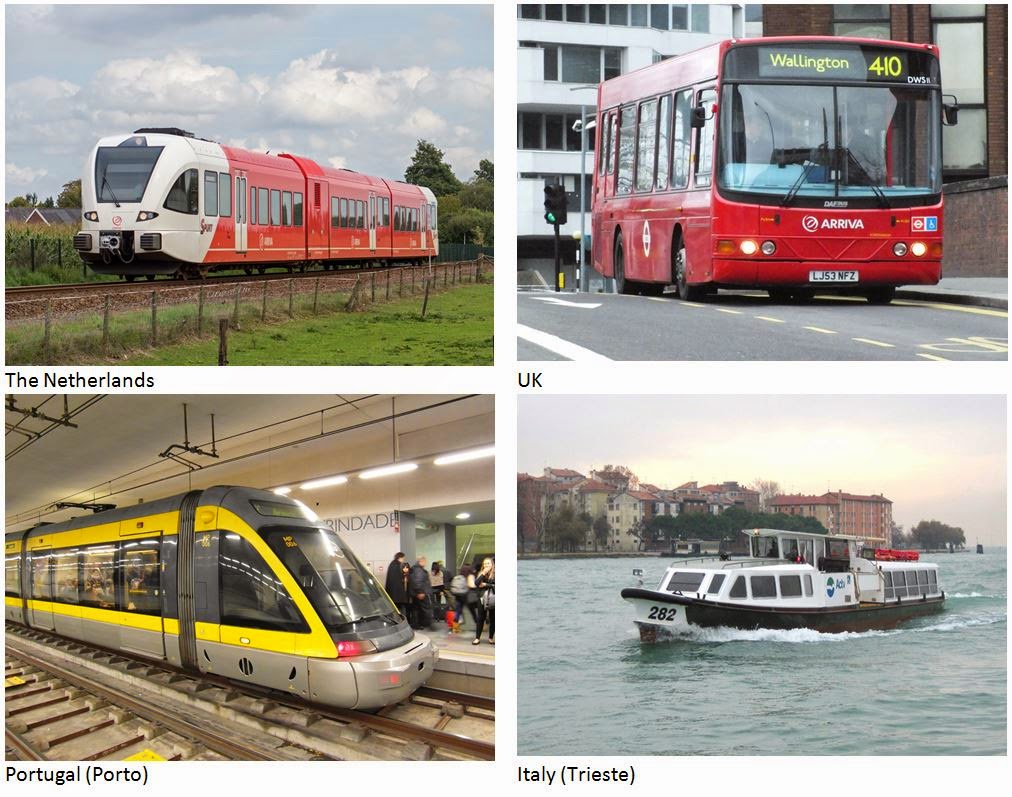
Since 1997, Arriva is the name of a public transport company established in 1938. In 2010, the company became a subsidiary Deutsche Bahn for the outside operations and is headquartered in Sunderland (UK). Arriva is one of the largest providers of passenger transport in Europe, employing more than 55,000 people and delivering more than 2.2 billion passenger journeys across 14 European countries each year. The company operates a wide range of services including local buses, inter-urban commuter coaches, local, regional and national train services, trams and light rail, waterbuses, demand response, non-emergency patient transport and airport related transport services: 


Rail services
Arriva European rail network spans the UK, the Czech Republic, Denmark, the Netherlands, Poland, Portugal and Sweden. The UK is the largest rail market of Arriva, where it operate six different train services, from the CrossCountry route spanning the length of England and Scotland to London Overground Rail Operations. The UK passenger rail market is at a mature stage of liberalisation. It is almost fully contracted and competitively tendered, with local service providers responsible for key areas such as timetabling. GNWR, GNER and Grand Central are part of Arriva. Elsewhere in Europe the market is opening up to tendering at different speeds. In Denmark, where Arriva operate 15 per cent of the regional network, the company was the first and only private company to be awarded a rail contract. In the Netherlands, where the market is mid-way through liberalisation, Arriva have a 60 per cent share of the open market as the sole provider of regional rail services in several areas.

Bus services
Arriva operates 19,500 buses across 14 European countries and cover many services from taking passengers to school and work, to the airport and even on sightseeing tours. The bus market in Europe is characterised by many different regulatory environments, ranging from complete liberalisation to state-run services in countries such as Hungary and Croatia. Having started out in the UK back in 1980, the company began his journey in the mainland Europe bus market with the first acquisition in Denmark in 1997. The largest bus market remains the UK, with a fleet of 5,900 vehicles providing services for customers in London, the rest of England and in Wales. The company have successfully established Arriva as a local market contender in many of these countries and expanded his bus services across Europe as a result. 


Light rail services
Arriva runs tram or light rail services in four countries across Europe. Sweden has a fully deregulated market and the company launched his first tram operations in 2007, while it won the ‘Pågatåg’ light rail contract and a second competitive contract in 2009, to run tram services between Göteborg and Örebro.  Arriva runs in Portugal and started operating the city of Porto’s tram contract, Metro do Porto in 2010, with 126 trams, as shown picture above, and also operate six trams in Italy. In UK, Arriva’s light rail services are based in the heart of the North East, serving some 40 million passengers every year with the Tyne and Wear Metro, which consists of 60 stations on a network shared by national rail passenger and freight services.

Waterbus services
Arriva provides waterbus routes on canals and in harbors within Denmark, Italy and the Netherlands. In the Netherlands, where Arriva run 12 waterbuses to the south of Amsterdam, around half of the routes are competitively tendered. In Italy there are four waterbuses provide essential passenger services for customers in Trieste and in Denmark, the company operates three waterbuses in the capital, Copenhagen.

See many more pictures on this album
Website of Alliance Rail Holdings (Arriva UK) on this link


Open Access/Liberalization - key figures

See also the facebookpage of Mediarail.be, comment on Twitter and LinkedIn
(version en français)

Other key figures - back to Homepage

Europe & World – railway policy

Liberalization is a creation of an open railway market. Open Access is a right for a train operator to enter on an existing market and to compete with the incumbent. There is therefore well, on the railway lines referred, two or more competitors providing the same services in the same stations, but not the same price. This is the case for all freight railway services and few passengers transport companies.

Thus it should not be confused with competition FOR the market. In this case, it is assigned a monopoly of service for 10 or 15 years to the company which has made the best offer. This is the case mostly used in Europe for the attribution of regional public transport services.

Why this policy ?
The aim of this policy has been to promote the efficiency and competitiveness of the railways through gradual liberalization. Indeed, according its promoters, most aspects of price and quality are run as ministries or as state administrations, and railways are fettered in their ability to operate as a business. For Europe, the railroads are considered as a central piece of the transport policy regarding the fight against pollution and congestion of cars and trucks on the road. In January 1990 the European Commission (EC) prepared the White Paper Communication on a Community Railway Policy for the Council of Ministers. This was the starting point of an active involvement of the Community in rail policy, where it has been necessary to produce four railway legislative packet and more than 25 years of work to achieve the first tangible results.

Which results today ?
1990-2000. The first sector which was entered to an existing market, since years 90’, was the freight sector, particularly in Germany, UK, Netherlands, Italy and Sweden. Passenger’s traffic has followed the movement of liberalization but in a diversified manner. Since years 90 in UK and in Sweden, later in Germany or in Netherland, many regional networks have been subject to a call for tenders, without awaiting the adoption of the European railway packages. In this case, that's a entry for a market with a monopolist service for a given time, both for railways services and for bus services. This is more practiced in federal countries of north of Europe rather than the south.

2003. The official year where Europe opens the freight market and this concerns mainly many traction companies rather than logistics companies.  The best-known are: ECR, EWS, Europorte, Crossrail, ERS, BoxXpress, ITL, RTC,...

2010. Since this date, the right access on a railway infrastructure can be used only for international passenger traffic. Today, Thello is the only one which uses this opportunity between Venice and Paris and on the Milan-Marseille route. It is thought that Eurostar and, later, Thalys or DB International, will follow the same path to become really independent companies. But there exist more national examples, as shown below, where two or three companies compete on the same line and in the same stations:


2019 or 2023 or…? The last step of the liberalization foreseen by European Union. This concerns the regional traffic where all markets will be submitted obligatorily to call for tenders. In this case, the historical incumbents can no longer valorize their monopolistic situation, what provoques in many countries a big political resistance. Indeed, we enter here on the field of public services and its staff who benefits of specific working conditions. It is the object of a part of the fourth rail package, which is subject to a political ping-pong within the European Commission.

To read : the role of open access in UK